
It Will Not Be a Short War
Only Realism Can Maintain American Primacy

The Vermont Daily Chronicle published my realist assessment of geostrategic threats in which I argue that the United States should deprioritize the Middle East and concentrate its finite military resources in the Indo-Pacific.
Contrary to the structural realism I advocated, the comments section of the article, “Realpolitik Priorities in Foreign Affairs,” centered on black-and-white moral imperatives, existential villainy, and political loyalty tests. I’ll call this operating system “Manichean Politics” after Manichaeism – an ancient Persian religion that divided the cosmos into an absolute duality of good versus evil.
Applying a dualistic moral lens to international politics leads to strategic failures and chronic overreach because nation-states (even hostile ones) are rational actors. Decision making is driven by security concerns, economic interests, military capabilities, and survival – not by metaphysical evil.
Both the neoconservatives in the George W. Bush Administration and Barack Obama’s liberal interventionists practiced Manichean Politics. It resulted in endless wars in the Middle East, new regional adversaries, military exhaustion, a multi-trillion-dollar price tag, and degradation of American power on the global stage.
Rather than reducing complex international relations to a morality play, realism focuses on resources, opportunity cost, and trade-offs. It asks these core questions:
Who can actually hurt America’s position in the world?
What price in blood and dollars must we pay to address that threat?
In this follow-up, I address the objections raised to my argument for treating Iran as a low-priority theater.
Objection 1: Iran poses an existential threat that must be dealt with now.
Manichean Politics – The Iranian regime chants “death to America.” Tehran is a permanent existential villain that wants nuclear weapons and sponsors regional terrorism through its proxies. Showing restraint amounts to weakness.
According to various polls, Americans over the age of 45 (Gen X and Boomers) rate Iran as a higher threat than Millennials and Gen Z. The 444-day hostage crisis (1979–81) was nightly television trauma for them, reinforced by the Iran–Iraq War (1980–88) and bombings in Beirut, Lebanon (1983) and Khobar, Saudi Arabia (1996). Iran looms large in their collective memory.
Structural Realism – In 2026, Iran is a third-rate regional actor with a severely degraded proxy network (e.g., Hezbollah in Lebanon, Houthis in Yemen).
Iran has no blue-water navy that can cross the Atlantic, no long-range strategic bombers, and no missile system that can hit the homeland. It has no conventional ability to attack America; its military is built for regional defense.
The ruling Shia clergy pursued uranium enrichment for the same reason that North Korea’s Kim dynasty developed a nuclear arsenal – regime survival. However, U.S.-led airstrikes last June “obliterated” key parts of Iran’s nuclear infrastructure, setting it back by decades and neutralizing this threat for the foreseeable future. President Donald Trump highlighted the resounding success of the 2025 strikes during his State of the Union speech on Tuesday.
Objection 2: America has a moral duty to act. We cannot sit back while the Iranian regime slaughters civilians.
Manichean Politics – Are you okay with evil winning?
This rhetorical framing replaces the strategic question –“What is Iran’s actual capacity to harm key U.S. interests?” – with a moral binary of heroism versus cowardice. It turns a pragmatic assessment of threats to U.S. hegemony into a betrayal of Americans in uniform.
Structural Realism – No one condones the murder of innocent people. But moral duty without prudence leads to endless wars wherever tyranny reigns.
Both neoconservatism and liberal interventionism fail to account for the political consequences of seemingly moral action. U.S. regime-change operations in Iraq, Libya, and Syria resulted in larger death tolls, more refugee displacements, and greater regional instability. President Trump ran on an “America First” platform that rejects the discredited neocon/liberal playbook.
Moreover, supporting Americans in the military involves protecting their readiness. The USS Abraham Lincoln, now stationed in the Gulf of Oman, was pulled from its Pacific deployment last month. The USS Gerald R. Ford, redirected from Caribbean operations to the Persian Gulf, has been at sea for nine months. According to the Wall Street Journal, the carrier’s vacuum sewage system (serving 650 toilets) has experienced repeated failures. Sailors faced daily blocked toilets, leaks, and overflows, forcing the ship to make an unscheduled stop in Greece for repairs.
Objection 3: Questioning the Administration’s Middle East posture is disloyalty to Trump.
Manichean Politics – Trump is playing 4D chess based on classified intel. He’s a master of misdirection.
This frame protects the President’s image as a political genius, casting those who question the Persian Gulf buildup as disloyal.
Structural Realism – “America First” decisively breaks with neoconservative and liberal foreign policy models, which mired the U.S. in a cesspool of blood feuds and sectarian conflicts across the Middle East and Afghanistan for decades. Loyalty to the MAGA movement entails staying true to its promise of “no more forever wars.”
Furthermore, a February 2026 University of Maryland poll found that only 21 percent of Americans favor attacking Iran. Another trillion-dollar war would squander the President’s political capital and derail his ability to fulfill the “America First” mandate.
Objection 4: The Administration is projecting American strength against Iran, Russia, and China.
Manichean Politics – Amassing enormous firepower in the Persian Gulf will intimidate the new Axis of Evil.
Structural Realism – Parking two carriers and their respective strike groups, along with significant airpower, in a low-priority theater will not faze Xi Jinping. America’s “simultaneity problem” – as the Pentagon describes it in the 2026 National Defense Strategy – is no secret. The U.S. military is not sized, structured, or equipped to simultaneously conduct protracted wars in multiple theaters.
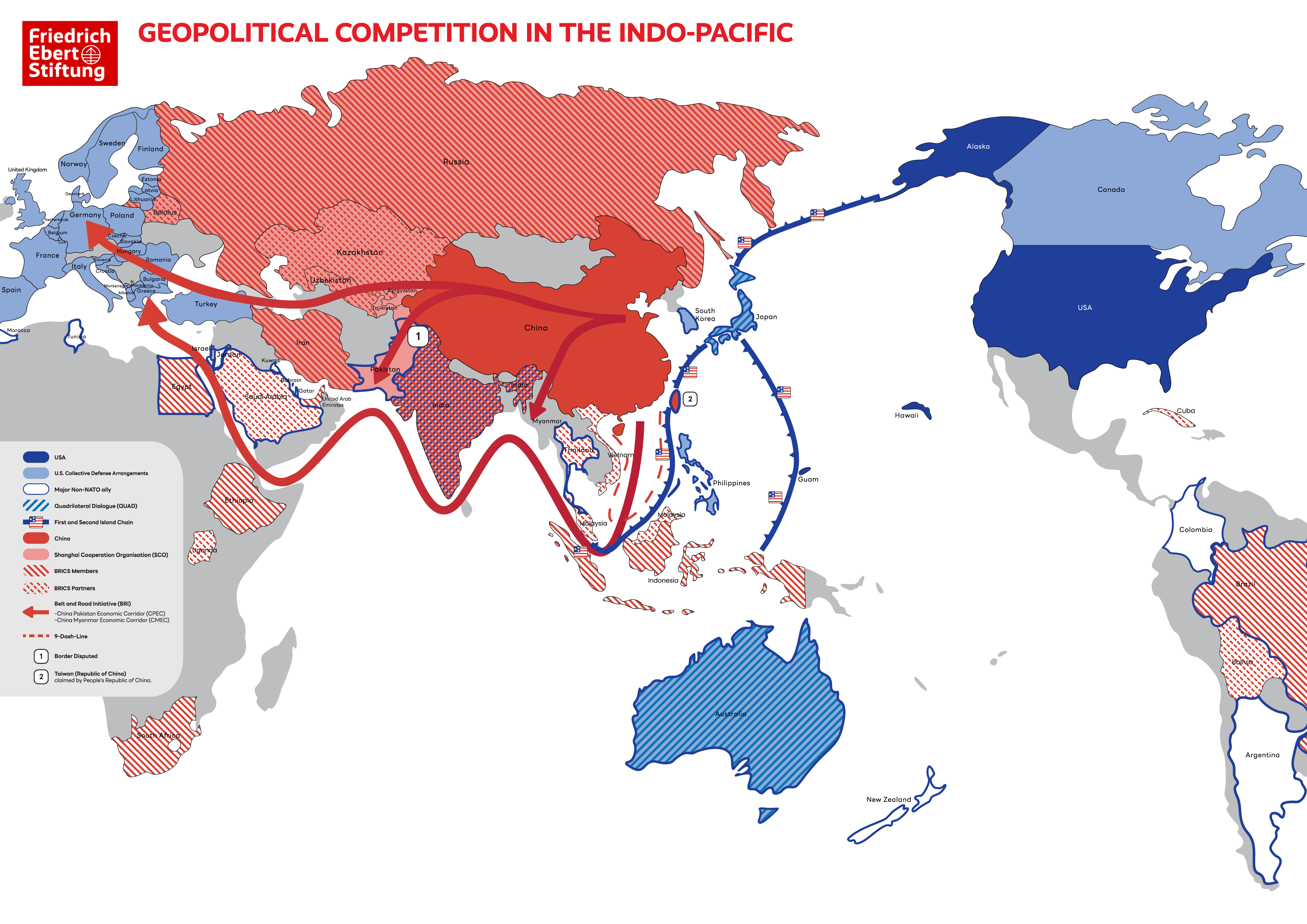
China is building anti-carrier hypersonic missiles and a nuclear-powered submarine fleet, militarizing artificial islands in the South China Sea, and expanding its deep-sea port network from Pakistan to Djibouti. Effective deterrence therefore calls for the accumulation of high-value U.S. military assets in the Indo-Pacific.
Only by prioritizing military readiness against its peer competitor China, while securing its borders and backyard, will the United States maintain primacy in the world.